Southwark – Peter John – the full ABC interview
November 17th, 2016
UPDATE: Read Heygate profits north of a hundred million by 35%.org
HT @adjournist retweet
This interview has triggered thoughts I’d tried to bury about the entitlement of leaseholders to be treated as fairly as secure tenants on a council estate, complicated by the fact I detest right to buy but count two leaseholders (second generation) among my friends. I will attempt to unravel the interwoven threads of the conflict with reference to the comments of Peter John in the interview linked above.
Forgotten Estates: at last, the video
November 15th, 2016
Like many other London events I don’t get to, I had a ticket for this, it looked interesting, and now the Royal Academy have posted the video. So if, like me, you couldn’t get there the recording is here to watch:-
From left to right
Kate Macintosh – Architect, formerly of the London Boroughs of Southwark and Lambeth, and East Sussex and Hampshire County Councils; designer of Dawson’s Heights, East Dulwich (1964–72)
Dawson’s Heights – my walk with C20th Society
Mark Crinson – Professor of Architectural History, Birkbeck, University of London
who spent twenty minutes being rude about the Smithsons. He made no attempt to hide the fact that he doesn’t like RHG or the people who designed it. Watch the debate and decide for yourself.
The Smithsons on housing – watch the film and see what you think
Owen Hopkins – Architecture Programme Curator, Royal Academy (chair)
Jessie Brennan – Artist; author of Regeneration! Conversations, Drawings, Archives & Photographs from Robin Hood Gardens (2015)
Dr Paul Watt – Reader in Urban Studies, Birkbeck, University of London
An excellent history of council estates from right to buy to the present day
Save Cressingham Gardens Judicial Review
November 14th, 2016
Judicial review report here:-
In reply to The Five Estates, Peckham, Part III: Back to the Future
November 4th, 2016
Firstly I was struck by a hypothetical question:-
“Would the regeneration have been necessary had the Thatcher cuts in maintenance been avoided and the inflation proofed money still been available?”
I suspect yes, owing to the change in residential makeup of the estates owing to the effects of right to buy (in subsequent decades companies and individuals bought onto council estates and let the flats to unemployed people on the then DSS thus further weakening the estate demographic) and the 1977 Housing Act – priority needs based lettings.
In my personal opinion the estates and council housing in general were damaged by those two pieces of legislation, the second of which was enacted under a Labour Government albeit with unintended consequences.
269 Leigham Court Road – sheltered housing under threat
May 25th, 2016

Once again I find myself reading an important piece about social housing under threat, this time in Streatham, which needs wider publicity but instead is tucked away on a private discussion group. So I’m giving it a wider view at risk of copyright violation. I’d like to make it clear that what follows was not written by me but I agree with it as written and trust the judgement of the author.
This is 269 Leigham Court Road in Streatham, currently sheltered housing, with 45 flats that are home to 50 residents, all over the age of 60, all on secure tenancies. Despite being designed by architect Kate Macintosh specifically to house elderly people, a duty it has performed since 1975, in January 2013 Lambeth Council suddenly declared the estate ‘unfit for purpose’, told residents that it was too expensive to do the repairs and maintenance they had neglected for years, and declared the site was to be ‘sold as cleared land.’
Why Open Garden Estates? – extracts
May 23rd, 2016

Why Open Garden Estates?
The aim [is] to help banish the myth of council estates as concrete jungles that are home to anti-social behaviour and crime, and show them to be what they are – some of the last instances of community living left in London, and perhaps the only remaining places where the mixed communities we hear so much about in the speeches of politicians have a chance to survive the encroachment of gated ghettos of predominantly white, middle-class wealth.
ASH presentation to Lambeth Council – Central Hill
May 19th, 2016
I think it needs to be known how Lambeth Council behave when confronted with alternative proposals to their demolition plans to the estates in the borough over which they presently have political control.
If you don’t follow ASH on Twitter or are not a member of the Facebook group or read their blog you will probably not be aware of the hostility they are up against on a day to day basis in putting forward an alternative method of dealing with the housing situation in Lambeth.
Once again therefore, rightly or wrongly, I feel it necessary to publish what happened the night ASH tried to present their alternative proposals for Central Hill to Lambeth Council.
You can read about the presentation itself on their blog here:-
https://architectsforsocialhousing.wordpress.com/2016/05/18/ash-presentation-to-central-hill-estate-residents-engagement-panel/
What you’re less likely to read is what follows, as published on the Facebook page. Once again I don’t know if I ought to be doing this but I think you are entitled to know, if you have any interest in the housing situation in London.
ASH on the Housing Bill
May 5th, 2016
I copied what follows off the ASH FB page. Perhaps I shouldn’t have done I don’t know – but what I do know is that every word of it rings true. This is a fight for the survival of council housing in the UK and if you think that’s an exaggeration then watch the Housing Bill pass and the housing crisis worsen inexorably.
Well, that was worth it. Further proof that the fight for council housing won’t be won in Parliament by the verbal outrage of landlords and company CEOs, but on council estates and by the direct action of the residents whose homes are threatened.
We need to stop asking the people and institutions that want to demolish our homes to give us the means to stop them doing so, and start organising our own resistance on the ground. That starts with the political awakening of every resident to the reality of what they are facing, which is not a policy disagreement between Tory and Labour but a class war being waged by the rich.
I’ve said this from the time we first read this Bill and I’ll repeat it again now. This Bill is not ‘badly thought through’, ‘written too quickly’, a ‘hodgepodge’, or ‘half-baked’ – as the Labour Party and its press have endlessly dismissed it as.
It is carefully designed to do exactly what it intends to do, which is bring about the end of social housing in this country. The Labour Party should understand this better than anyone, as it has been, and will continue to be, its councils that will implement the Bill’s legislation.
It is this truth that we need to face, and quickly, if we are to organise mass resistance to its attacks, not in A-B marches to Parliament, submissions to the House of Lords, or faith in the Second Coming of J.C. to miraculously reverse what’s going to happen to council housing over the next four years.
These measures, which have wasted the time and drained the energy of what limited opposition to the Bill there has been, have only served to divert our attention from what is really needed to oppose it, which is collective resistance by the hundreds of thousands of residents whose homes will be sold or demolished by the Housing and Planning Bill and the mass estate regeneration programmes its legislation will enable. – Simon Elmer
Calling leaseholders on estates under threat
May 4th, 2016
I found this by ASH (Architects for Social Housing) on their Facebook page and it’s too important to leave there so if you are a leaseholder on an estate threatened with redevelopment against your wishes then read, mark, and learn what follows:-
Apart from all this mucking about, one thing that came out of the presentations and discussions, and which was backed up by advice from a barrister and a leasehold lawyer, is that collective resistance by leaseholders forcing Councils to issue Compulsory Purchase Orders against them is one of the most effective ways to resist estate regeneration and save the homes of all residents, leaseholders and council tenants alike.
It costs the Council shitloads, allows us to question the consolation process at legal inquiries, put forward alternative plans and argue that they better represent the needs of the local community, and delays their demolition plans by years. It also casts an uncomfortably bright light on the Plato’s cave of illusions in which the public is imprisoned by the press.
If we can show every leaseholder on every estate in London why they should do this, then the Tory Government, Labour Councils, Savills, and all the other housing associations, building companies and property investors feeding at the London housing table might start to think again about whether estate demolition really is the easiest route to a quick buck. – Simon Elmer
Housing discussion at Tate Modern April 13th 2016
April 15th, 2016
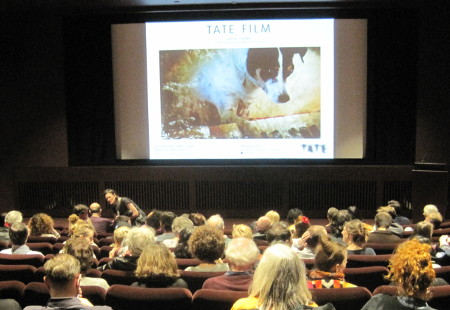
I attended a showing of Estate: a Reverie by Andrea Luka Zimmerman on Wednesday evening at the Tate Modern. Following the film an interesting discussion took place among six interested parties and from a poor quality recording I have transcribed some excerpts as shown below.